The conversation surrounding automation in digital advertising has undergone a radical transformation. A few years ago, automating your ad accounts meant handing over your budget to black-box algorithms, setting a target ROAS, and praying the platform's native AI wouldn't waste capital on junk inventory. Whether managing complex multi-client portfolios or scaling an in-house brand, marketers were trapped in a frustrating paradox: give up control for efficiency, or retain control and drown in manual execution.
Enter the era of AI agents. Unlike rigid, rule-based scripts or opaque platform algorithms, autonomous AI agents for ppc marketing act as intelligent co-pilots. They can analyze data contextually, execute complex workflows across channels, and make real-time optimizations based on true business objectives rather than isolated platform metrics.
But as we lean into AI for PPC, the core challenge for both growing agencies and enterprise in-house marketing teams is no longer about whether to automate, but how to do it safely. How do you scale operations and maximize efficiency with autonomous agents without losing your strategic grip? This guide explores the framework for deploying AI agents effectively while firmly keeping your hands on the wheel.
The New Frontier: Why "Platform AI" is Not Enough
To understand the value of dedicated AI agents, we must first address the elephant in the marketing room: platform-native AI. Tools like Google's Performance Max and Meta's Advantage+ have corporate priorities that don't always align with yours. Relying solely on them exposes both agencies and in-house teams to structural vulnerabilities.
The Conflict of Interest
Ad networks are marketplaces. Their primary objective is to maximize their own yield across all available ad inventory. When you allow a platform's native AI to completely dictate budget allocation, keyword selection, and placement, you are trusting a vendor to grade their own homework. For an agency, this can lead to awkward client conversations about wasted spend; for an in-house team, it directly burns corporate bottom-line profitability.
The Blind-Spot Matrix
Platform algorithms operate in absolute silos. Google has no visibility into your Meta Ads frequency, and Meta cannot see your Microsoft Advertising conversion paths. Furthermore, native platform AIs have no understanding of your internal business realities. If a sudden supply chain disruption or warehouse bottleneck occurs, platform algorithms will keep spending blindly until your budget runs dry.
Dedicated AI for PPC solves this by positioning autonomous agents above the ad platforms. These agents pull data from your CRMs, inventory management systems, and cross-channel dashboards, executing optimizations based on holistic business health rather than single-platform attribution models.
Operationalizing AI Agents Across Your PPC Framework
Deploying AI agents successfully requires shifting from a mindset of "manual task execution" to "algorithmic management." Instead of pulling levers yourself every day, your role, whether as an agency media buyer or an in-house digital marketing manager, becomes defining the operational guardrails within which your AI agents operate.
To see who is leading this technological shift right now, explore our detailed industry breakdown, The Top 10 AI Agents Revolutionizing PPC Marketing in 2026.
In practice, the model runs top down: your business strategy and guardrails define the rules, the AI agent layer (context-aware and cross-channel) executes within them, and the agents act across Google Ads, Meta Ads, and Microsoft Ads.
1. Strategic Budget Pacing and Fluid Cross-Channel Reallocation
One of the highest-leverage applications of AI for PPC is autonomous budget management. Instead of manual weekly updates or tedious spreadsheet math, AI agents monitor performance trends on a rolling hourly basis.
- The Agentic Workflow: If an agent detects that Google Search CPA is climbing past an acceptable threshold due to aggressive competitor bidding, it can automatically scale back spend and reallocate that capital into high-performing Meta retargeting pools.
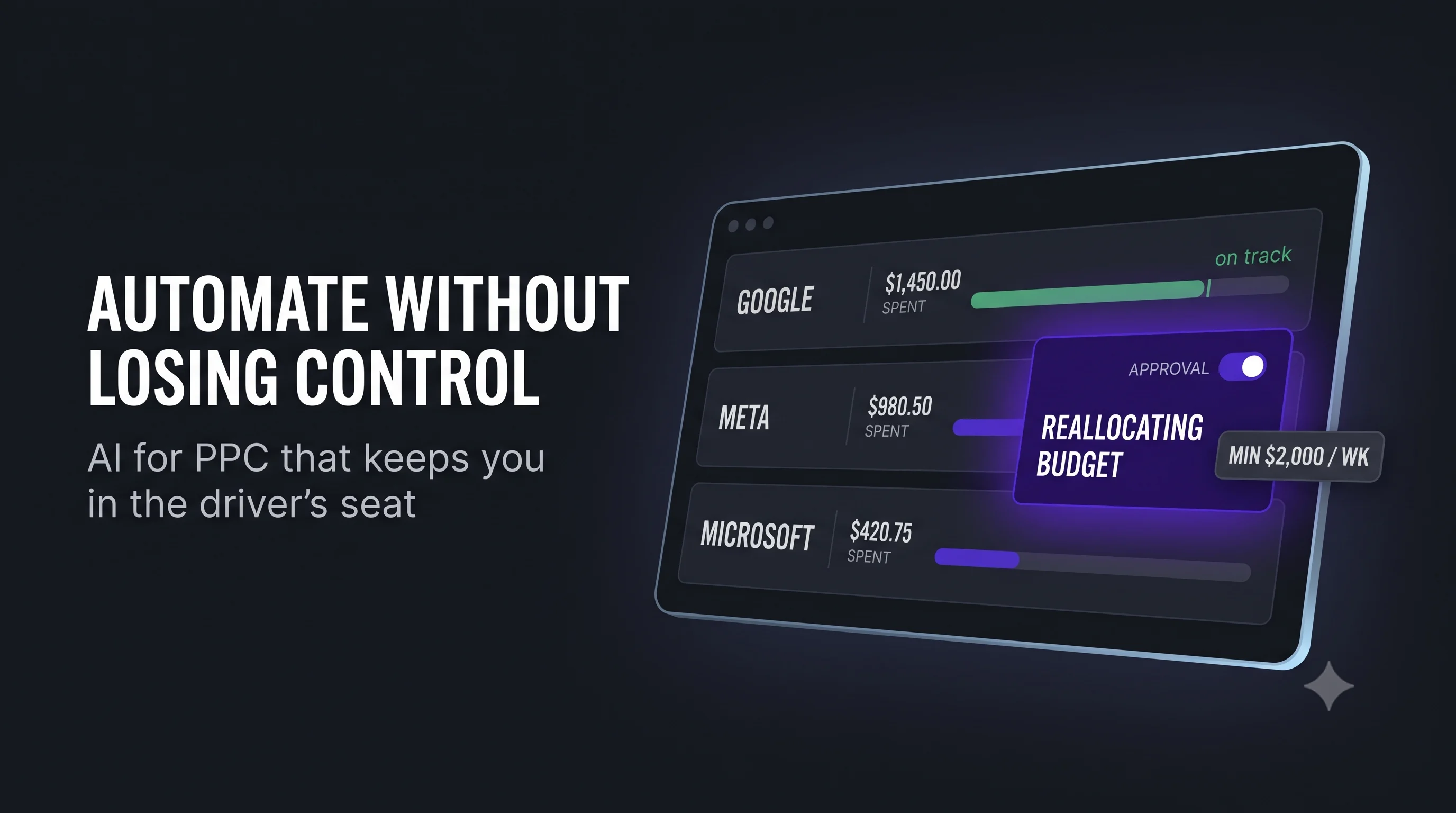
- The Steering Wheel: You retain control by setting hard boundary conditions. For instance, an in-house team can instruct the agent: "Dynamically shift budgets between platforms to maximize total blended e-commerce revenue, but ensure Google Ads spend never drops below $2,000 per week to protect our core brand equity."
2. Context-Aware Bid Management and Auction Anomalies
Traditional automated bidding relies heavily on historical data volume. If you encounter a sudden macroeconomic shift, an internal flash sale, or an unexpected corporate PR crisis, historical models break down.
- The Agentic Workflow: Advanced AI agents continuously parse external signals, such as weather data, local competitor pricing fluctuations, or sudden inventory drops and adjust bids in real-time.
- The Steering Wheel: Rather than giving the AI full pricing power, you implement absolute bid caps and value rules. This prevents the agent from entering hyper-inflated bid wars that erode product margins, keeping your cost-efficiency intact.
Balancing Creative Control with Autonomous Execution
The greatest friction point in adopting AI for PPC exists within the creative department. Creative assets are now the primary driver of performance, especially on visual-heavy networks. Agencies fear that automated agents will output generic, brand-diluting assets that compromise client relationships, while in-house teams worry about violating strict corporate brand guidelines.
This fear is valid, but it stems from a misunderstanding of how next-generation agents function. For a deep dive into maintaining your brand's unique identity while scaling paid social operations, read our dedicated guide, AI Agents & Meta Ads: Automate While Keeping Creative Control.
Standard Operating Procedures for Agencies vs. In-House Teams
While both organizational structures benefit from AI for PPC, their operational pain points differ. AI agents adapt fluidly to solve the unique scaling bottlenecks of both environments.
For Agencies: Handling Portfolio Scale
If your agency handles dozens of client accounts, the administrative burden of checking settings, auditing search terms, and updating exclusions can paralyze your growth. AI agents allow a single media buyer to oversee a larger portfolio safely by automating low-level diagnostics, ensuring that standard operating procedures are executed flawlessly and consistently across every single client roster.
The accounts that slip first are the small ones. A Microsoft Ads account launched from a Google import and reviewed once a month can run for weeks on conversion tracking that stopped recording, because nothing on the surface looks wrong. For the channel-specific version of this problem, read Microsoft Ads management: where AI agents earn their keep.
For In-House Teams: Deep Business Integration
In-house teams don't have to worry about managing 30 different clients, but they do have to worry about deep, cross-departmental alignment. An AI agent deployed in-house can connect directly to internal business systems:
| Internal Data Source | AI Agent Automated Action | Business Outcome |
|---|---|---|
| Inventory / ERP System | Automatically pauses ads for products with low stock. | Prevents wasted ad spend and poor customer experiences. |
| CRM Pipeline Data | Shifts optimization focus from raw leads to closed-won deals. | Maximizes true pipeline value over superficial platform metrics. |
| Margin Management Sheets | Lowers keyword bids if a product's wholesale cost rises. | Dynamically protects profitability and margins in real time. |
The AI Agent Stack: Integrating Kuma Agents into Your Workflow
Moving away from manual account firefighting requires an enterprise-grade infrastructure. You cannot manage a cohesive marketing engine if your team has to jump between five different point-solution AI tools that do not communicate with one another.
This is where Kuma Agents serves as the central orchestration layer for your entire paid media ecosystem. Designed specifically to provide unified, high-performance execution, Kuma Agents acts as an intelligent layer that sits directly on top of your Google, Meta, and Microsoft ad accounts.
In this setup, Kuma Agents is the top layer (unified monitoring, contextual AI, and smart routing), sitting above and feeding into Meta Ads, Google Ads, and Microsoft Ads.
Context-Aware Anomaly Detection
Rather than blasting your team with generic, high-volume alerts when performance fluctuates naturally, Kuma Agents interprets data within the specific context of each individual enterprise or client. It understands seasonal baseline shifts, complex budget structures, and channel relationships, meaning it only flags anomalies that represent genuine operational risks.
Proactive Strategic Recommendations
Kuma Agents doesn't just display historical data; it continuously evaluates your cross-channel footprint to deliver tailored, actionable recommendations. Whether it's identifying a critical drop in your Google Quality Score, predicting an end-of-month budget under-spend scenario, or highlighting an audience fatigue trend on Meta, the platform provides the clear strategic directives your media buyers need to maximize performance.
By utilizing Kuma Agents, your team, whether agency-side or in-house, stops acting as repetitive data aggregators and starts acting as strategic pilot directors, ensuring that every automated action perfectly aligns with broader business revenue goals.
Driving the Future of PPC
The future of digital advertising does not belong to the fully manual practitioner, nor does it belong to marketing departments that completely abdicate their responsibility to black-box platform algorithms. The future belongs to the augmented marketer, the professional who understands how to orchestrate advanced AI for PPC while maintaining strict strategic governance.
By establishing robust cross-channel guardrails, automating tedious diagnostic workflows, and deploying unified agentic platforms like Kuma Agents, you unlock unprecedented operational leverage. Whether you are scaling an agency portfolio or driving growth for an in-house brand, you protect your margins, eliminate costly human errors, and scale your operations effortlessly, all while keeping your hands firmly on the wheel of your marketing engine.