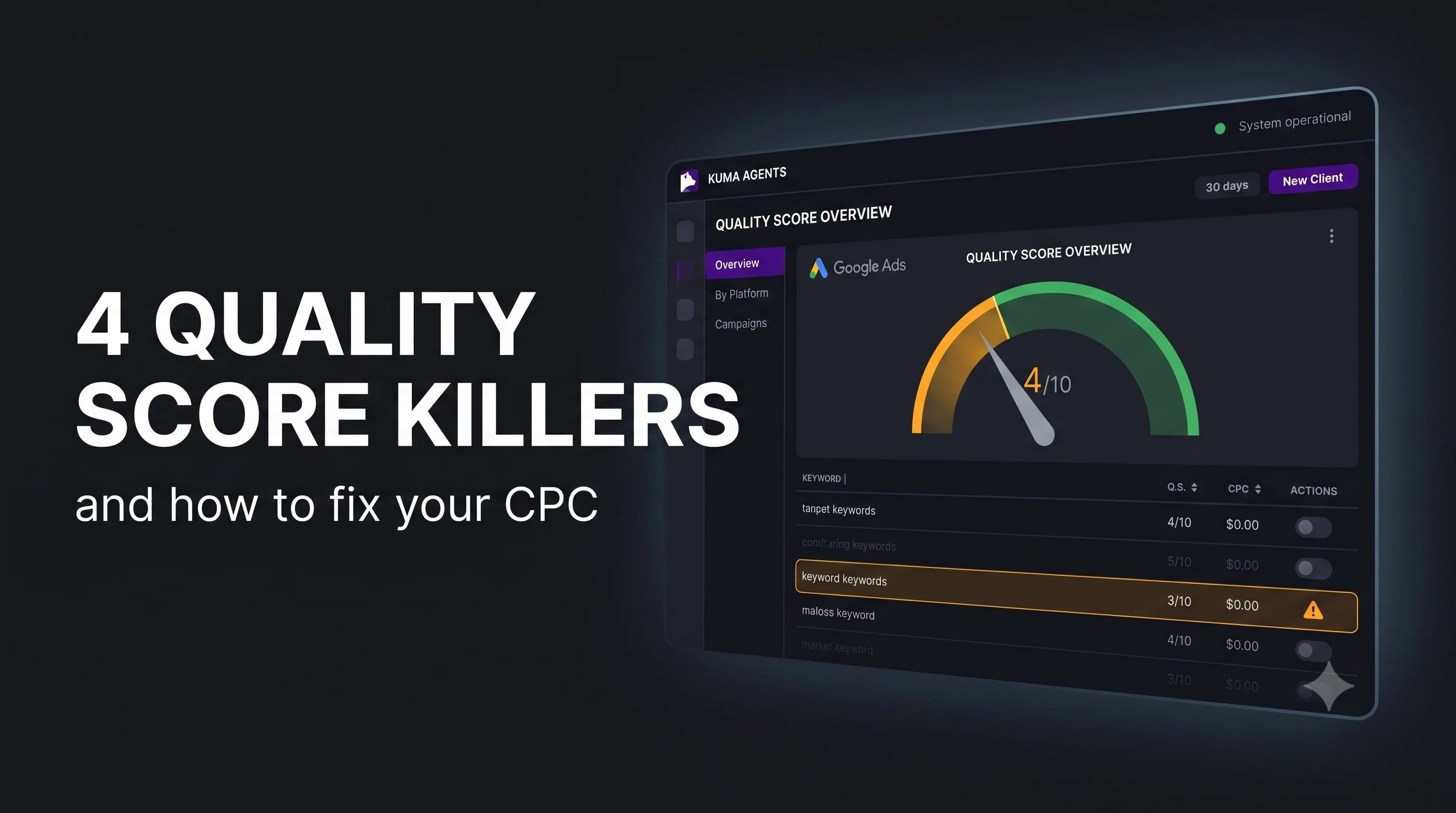
Your Google Ads Quality Score is a 1-to-10 diagnostic that rates how relevant your keywords, ads, and landing pages are to searchers. When it drops, your cost per click climbs and your ads show less. The usual suspects (ad copy, landing pages, click-through rate) are only part of the story. Here are the four sneaky culprits that quietly tank your score, and how to fix each one.
| The culprit | What it does to your score | The quick fix |
|---|---|---|
| Bloated ad groups | Dilutes Expected CTR and Ad Relevance at once | One tight theme per ad group |
| A landing page that breaks the promise | Drags down Landing Page Experience, the heaviest lever | Match the page to the ad, speed up mobile |
| Ad copy that ignores intent | Lowers Expected CTR versus competitors | Put the keyword and a clear benefit in the headline |
| Account history and messy search terms | Poisons the signal across the whole account | Add negative keywords, prune dead keywords |
What Your Google Ads Quality Score Actually Measures
Google builds your quality score in Google Ads from three parts: Expected click-through rate, Ad Relevance, and Landing Page Experience. Each keyword gets rated Below Average, Average, or Above Average on these. Google calls it a diagnostic tool, not a number to chase.
Here is why you should care anyway. Your score feeds Ad Rank, and Ad Rank sets both your position and what you actually pay. A better score means a lower cost per click for the same spot. A worse score means you overpay, click after click.
Most accounts sit at a 5 or 6, so a 7 already beats the field. A 10 is rare and rarely worth the chase on competitive terms. Aim for "good," not "perfect."
Culprit #1: Bloated Ad Groups That Try to Say Everything
The most common score-killer is an ad group stuffed with loosely related keywords. When one group holds "running shoes," "trail shoes," and "cheap sneakers," your ad cannot speak to any of them. So your click-through rate sinks and your Ad relevance drops with it.
Think of it this way: if an ad tries to be relevant to every search, it ends up relevant to none. Two of your three score components take the hit from the same mistake.
Say you run one ad group with 40 mixed keywords and a Quality Score of 4. Split it into four tight groups of 10, each with its own headline, and the same keywords often climb to a 7 or 8. Same budget, lower cost per click.
Pro Tip: Keep one clear theme per ad group. Fewer, tighter keywords beat one giant group every time, because your ad copy can finally mirror the exact search.
Culprit #2: A Landing Page That Breaks the Promise
Someone clicks an ad for "blue running shoes" and lands on a generic homepage. They bounce. Google notices. That is Landing Page Experience, and it is the component most teams ignore, because the page often lives outside the ads tool.
Speed matters too. One e-commerce account lifted a keyword from a 6 to a 9 in two weeks just by cutting mobile load time from 4.8 seconds to 2.1 seconds.
What "message match" really means
The page has to answer the exact search. If the ad promises emergency boiler repair in London, the page headline should say emergency boiler repair in London, not "heating services." Match the words. Match the offer. Make it fast on mobile.
Culprit #3: Ad Copy That Ignores the Search Intent
Expected CTR is Google’s guess at how often people will click your ad, compared to every other advertiser on that keyword. It is not your own past CTR. It is a contest against the field. Generic copy loses that contest.
A simple before and after
Before: Someone searches "socks with polka dots" and sees an ad that says "Quality Socks. Shop Now." It is vague. The click rate stays low.
After: The same search sees "Polka Dot Socks, 50% Off Today." It names the exact thing and gives a reason to click. Expected CTR rises, and your score follows.
Pro Tip: Put the keyword in at least two headlines of every responsive search ad, and lead with one clear benefit. Then test new headlines often, and pause the losers.
Culprit #4: The Sneaky One, Account History and Messy Search Terms
This is the culprit nobody flags, because it sits outside the three official components. Google scores partly on history. A pattern of low click rates and irrelevant traffic tells Google your account needs work, and that reputation follows your new keywords too.
The hidden driver is your Search Terms report. Broad match keywords pull in searches you never meant to target. Those off-target impressions and weak clicks drag your numbers down across the board. The score you see today is a lagging snapshot of all that noise.
The fix is housekeeping most accounts skip. Negative keywords are not just a budget tool. They protect relevance by stopping your ads from showing on searches that will never click or convert.
- Open the Search Terms report and sort by spend.
- Add negative keywords for every off-target search you find.
- Pause keywords that have run for months with low click rates and no conversions.
- Give the account a few weeks of clean data, then recheck the scores.
Watch out : Quality Score lags by days. If it drops from a 6 to a 5 overnight, do not rewrite every ad in a panic. You are looking at the echo of something that already happened. Fix the structure, then wait for fresh data.
How to Improve Quality Score in Google Ads Without Raising Your Bids
You do not need a bigger budget to fix this. Google Ads quality score optimization is about relevance and structure, not spend. Here is a simple order of operations that works on almost any account.
- Find the money keywords. Filter for keywords with a Quality Score under 7, then sort by spend. Fix the expensive ones first.
- Read the flagged component. For each keyword, see which part is "Below Average." That tells you where to look.
- Fix one layer at a time. Low Expected CTR means rework the ad copy. Low Ad Relevance usually means tighten the ad group. Low Landing Page Experience means fix the page, not the ad.
- Re-check after a few weeks. Scores move within days to weeks once real data comes in. Track the trend, not the daily wiggle.
Use the table below to match the symptom to the fix.
| Flagged component | Most likely cause | What to fix first |
|---|---|---|
| Expected CTR | Weak or generic ad copy | Rewrite headlines to match intent and add a clear benefit |
| Ad Relevance | Ad group too broad | Split the group; put the keyword in the copy |
| Landing Page Experience | Page mismatch or slow mobile | Match the page to the ad; cut load time under 3 seconds |
Catch Google Ads Quality Score Drops Before They Drain Your Budget, with Kuma Agents
Doing all of this by hand is slow. On one account it is doable. Across ten or thirty accounts, weak Quality Scores hide in plain sight until the cost per click has already climbed. That is the gap Kuma Agents was built to close.
Kuma Agents connects to your Google Ads account and monitors it continuously. It flags the keywords where Quality Score is dragging, points to the component that is failing, and hands you a clear recommendation instead of a vague alert. The boring diagnostic work that you keep meaning to do gets done, on schedule.
It is not magic. It is rules and checks, run by AI agents that know the context of your accounts, applied to the patterns that quietly drain budgets. The kind most teams know about but never quite get around to fixing.
To automate the analysis and the optimization recommendations for your Quality Scores, discover Kuma Agents with a free Google Ads audit.
Frequently Asked Questions
What is a good Quality Score in Google Ads?
A 7 or higher is generally good for non-brand keywords. Most accounts average a 5 or 6, so a 7 already puts you ahead of the field. Brand terms can and should hit 9 or 10, because they are highly relevant by nature. A 10 on competitive non-brand terms is rare and usually not worth the effort it takes.
How long does it take to improve a Quality Score?
It depends on traffic volume, but most changes show up within days to a few weeks. The score is based on historical data, so it lags behind your edits. After you tighten an ad group or fix a landing page, give the keyword enough new impressions to refresh the score before you judge the result.
Does Quality Score directly set my cost per click?
Not on its own. Quality Score feeds Ad Rank, and Ad Rank sets your position and price. The simplified formula is your max bid multiplied by ad quality. A higher score lets you win the same position for less, which is the whole reason it matters.
Is Quality Score the same as Ad Rank?
No. Quality Score is a 1-to-10 diagnostic you can see in the keyword table. Ad Rank is what actually decides each auction, and it factors in your bid, real-time quality signals, ad assets, and the searcher’s context. Quality Score is the gauge; Ad Rank is the engine.
Does Performance Max have a Quality Score?
No. Performance Max does not use keywords the traditional way, so there is no keyword-level Quality Score. The closest signal is the asset group rating: Low, Good, or Best. A Low rating works like a poor Quality Score, limiting reach and raising effective costs.