Every PPC audit tool checks your account against somebody's idea of what a good account looks like. The tools differ less in what they check than in whose judgment is encoded, how recently it was refreshed, and what happens when a check turns out to be wrong. This comparison covers seven PPC audit tools, what each one costs, which platforms it can actually see, and where its checks come from.
| Your question | The short answer |
|---|---|
| What does a PPC audit tool cost? | From free (TrueClicks, Adzooma) to $209 and up per month (Optmyzr). Paid plans start at $69 (Adzooma) and $39 per ad account (Kuma Agents). |
| Which tools audit Meta Ads? | Optmyzr, Adzooma and Kuma Agents. Adalysis, TrueClicks and Opteo are search only. |
| Can any of them fix what they find? | Some. TrueClicks and Adzooma flag and stop. Optmyzr, Adalysis and Kuma apply changes you approve. |
What a PPC audit tool actually does
A PPC audit tool connects to your ad accounts through the platform APIs, runs a list of checks against what it finds, and returns the gaps between how the account is set up and how it should be set up. Structure, budgets, bidding, conversion tracking, search terms, creative, targeting.
That list of checks is the product. Everything else, the dashboards, the scores, the reports, is presentation. Two tools pointed at the same account will return different findings because they were taught to look for different things.
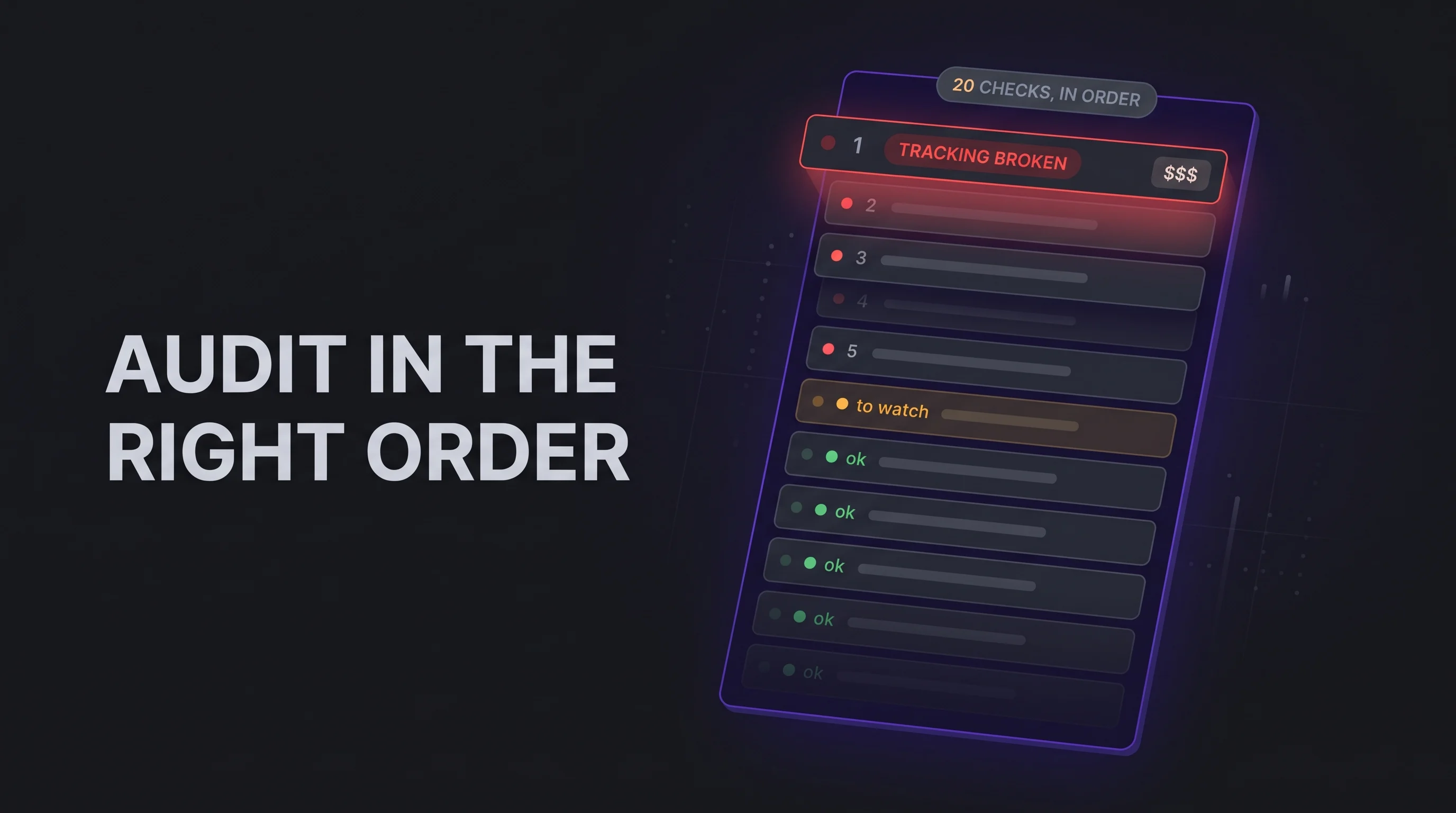
Where tools separate is in what happens next. Some hand you a report. Some stage a change you approve. A handful apply fixes directly through the API. That difference matters more than any feature list, because a finding nobody acts on costs exactly as much as a finding nobody made.
Audit, monitoring, and why the words get mixed up
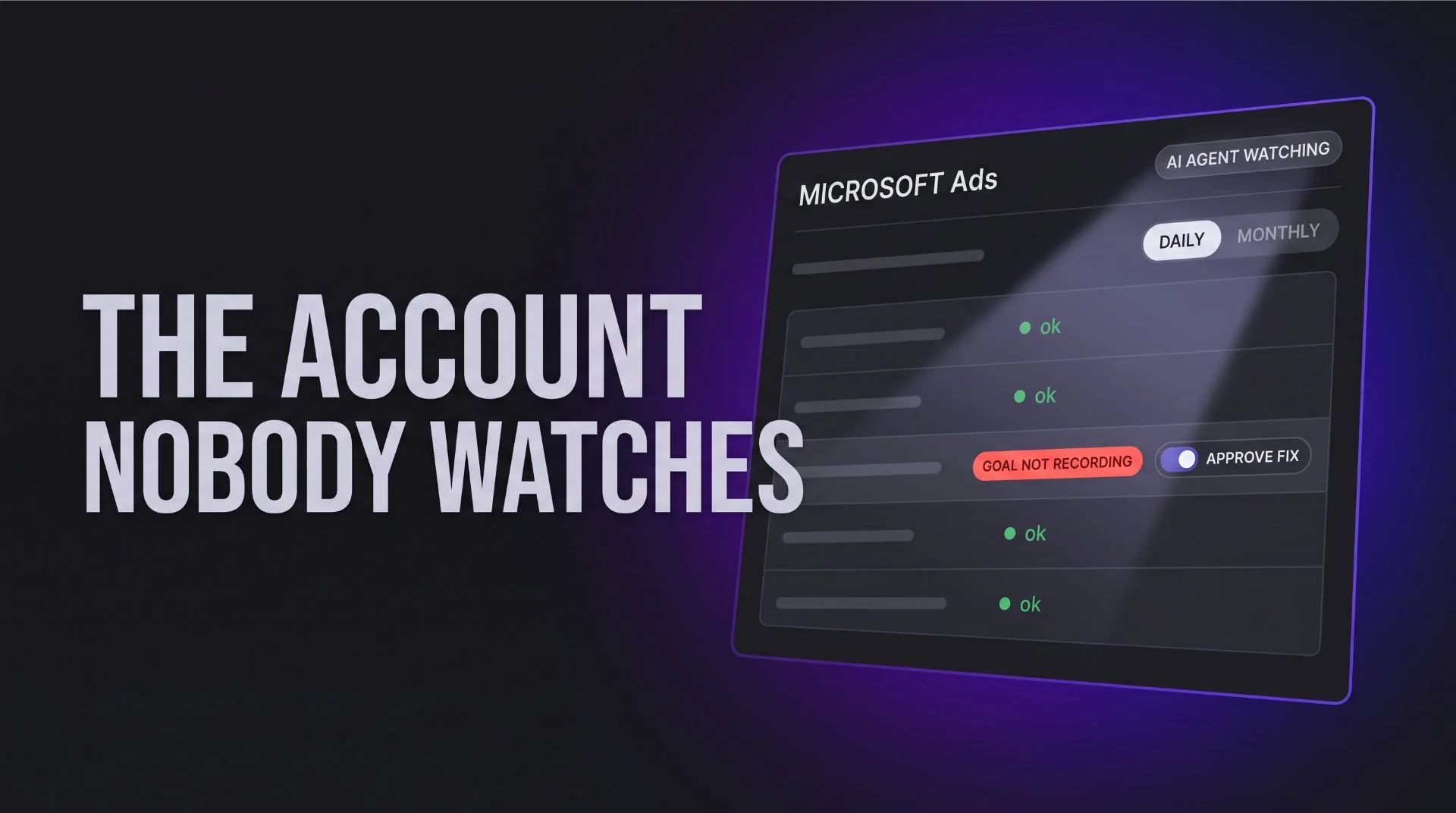
An audit is a point-in-time review of an account. Monitoring is the same checks running on a schedule, so a problem surfaces the week it starts instead of the month it shows up in a report. Most tools sell both and use the words interchangeably, which makes comparison harder than it needs to be.
The practical question is frequency. An account audited once a quarter will spend most of the quarter in whatever state it drifted into. Daily or weekly re-auditing turns a one-time cleanup into a standing guardrail.
Every audit tool is somebody's expertise, frozen at a moment in time
This is the part most comparisons skip, and it decides more than pricing does.
Audit checks do not write themselves. Somebody with real experience decided that a frequency above 4 on a warm audience is a problem, that a Maximize Clicks strategy on a conversion campaign is a misalignment, that 30 % of spend on brand terms inside Performance Max is worth flagging. These tools are not faceless. Optmyzr was co-founded in 2013 by Frederick Vallaeys, one of Google's first 500 employees and the company's first AdWords Evangelist. Adalysis grew out of the work of Brad Geddes, author of Advanced Google AdWords.
So the honest question is not whether a tool has expertise behind it. They all do. The question is when that expertise was last corrected against a live account.
The three questions worth asking any vendor
Before you pay for a PPC audit tool, ask the vendor these. The answers separate tools faster than a feature matrix does.
- Who wrote this check, and are they still managing accounts today?
- When was this check last changed, and what triggered the change?
- What happens when a check is wrong on my account? Who hears about it, and how long until it is fixed?
A tool built on a prebuilt library updates on a product roadmap. A quarter is a long time in paid media. Google shipped AI Max for Search, Demand Gen absorbed Display, Performance Max changed what it reports, and consent mode rewrote how conversions get attributed. A check written against last year's platform can be confidently, fluently wrong.
How we compared these seven tools
Five criteria, chosen before we looked at the tools, and applied the same way to all of them including our own.
- Platform coverage: which ad networks the tool can actually audit, not which ones it reports on
- Depth of checks: how many, and whether they go past surface metrics
- Acting on findings: whether the tool can apply a fix or only flag one
- Pricing model: what the bill follows as you grow, and where the caps sit
- Transparency: whether pricing and platform coverage are published clearly enough to verify
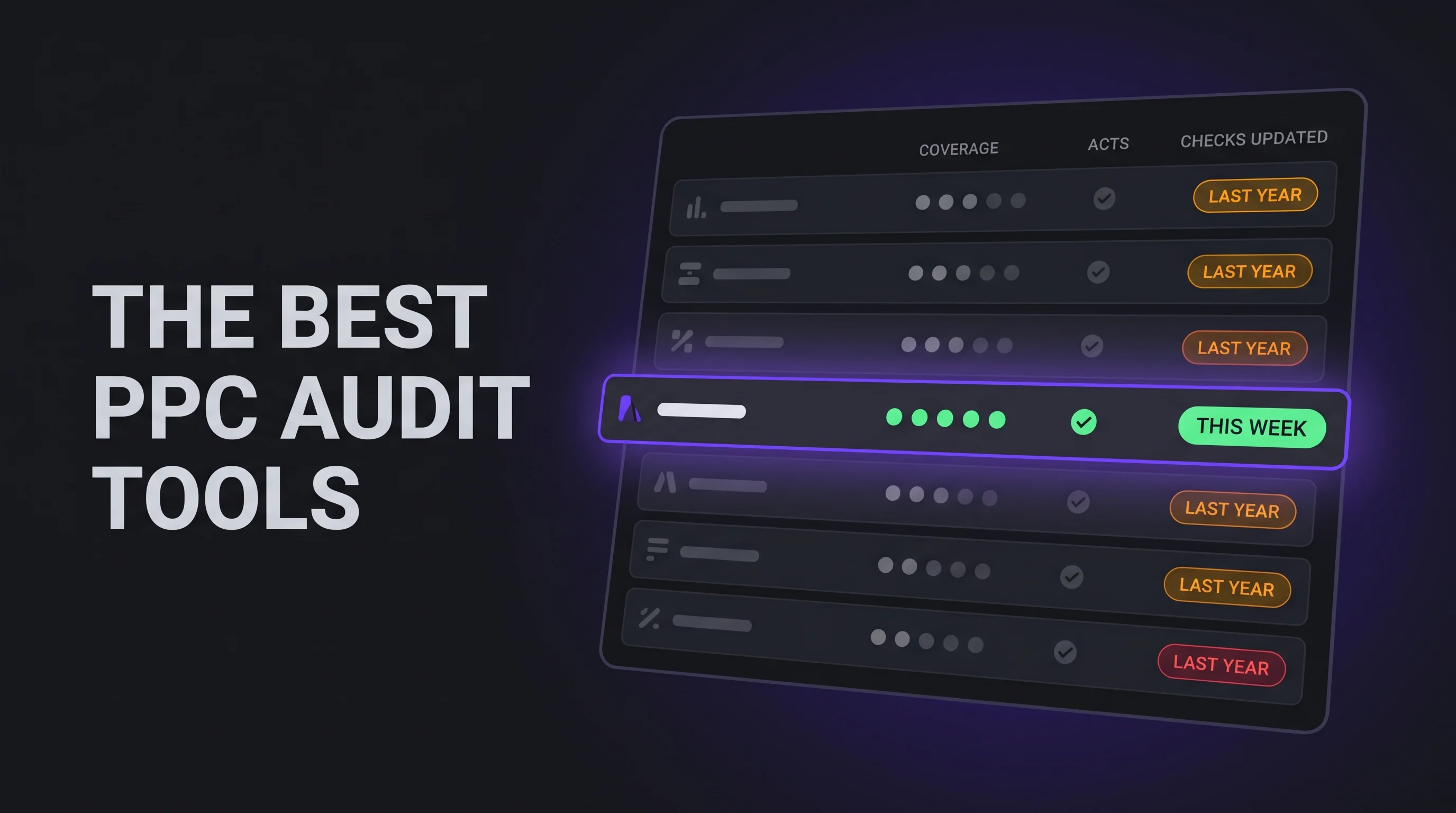
| Tool | Platforms audited | Entry price | Acts on findings |
|---|---|---|---|
| Optmyzr | Google, Microsoft, Amazon, Meta, LinkedIn, TikTok | From $209/mo, by spend tier | Yes, one-click optimizations |
| Adalysis | Google, Microsoft | From $149/mo, by max ad spend | Yes, in-platform fixes |
| TrueClicks | Google, Microsoft | Free, then $249/mo | Limited, staged fixes |
| Opteo | From $129/mo, capped accounts | Yes, suggestion-based | |
| Adzooma | Google, Microsoft, Meta | Free report, then from $69/mo | Largely read-only |
| Ryze AI | Google, Meta, TikTok, LinkedIn and more | Sales-led, not published | Yes, autonomous |
| Kuma Agents | Google, Meta, Microsoft | $39 per ad account/mo | Yes, where a fix applies |
The seven PPC audit tools, compared
Optmyzr, the deepest toolbox if you have time to learn it
Optmyzr is the most complete product in this category. It integrates with Google Ads, Microsoft Ads, Amazon Ads, Meta Ads, LinkedIn Ads and TikTok ads.
Two trade-offs. The platform is weighted heavily toward Google, and several reviews note the Meta tooling is thinner than the Google tooling. Pricing is tiered by ad spend, starting around $209 a month on annual billing and climbing into the high hundreds, so your bill follows your clients' media budgets. The learning curve is real, and for an in-house team without a dedicated PPC specialist it can become expensive shelfware.
Best for: agencies with PPC specialists on staff who will use the automation depth.
Adalysis, strong search auditing with automated ad testing
Adalysis audits Google Ads and Microsoft Ads against what it advertises as 100+ prebuilt checks, and adds a rule engine, budget management and automated ad testing. Every plan includes unlimited accounts and unlimited users, with the price set by your maximum monthly ad spend, starting from $149 a month.
The unlimited accounts policy is genuinely good value for an agency with a long roster of smaller search accounts. The automated ad testing has been built out over years and nothing else in this list matches it. The limit is the platform list: Meta spend is invisible to it, which for most advertisers means a large share of the media plan never gets audited at all.
Best for: search-only agencies running many accounts, especially if ad testing is central to how you work.
TrueClicks, the free plan that embarrasses paid tools
TrueClicks runs continuous auditing on Google Ads and Microsoft Ads, scores each account, and flags issues and budget pacing problems. Its free plan includes unlimited Google and Microsoft accounts, unlimited users on the same email domain and 80+ auditing checks for Google Ads, with one free plan per company.
One detail worth knowing: TrueClicks does not appear as a user or manager in your Google Ads or Microsoft Advertising account, and changes made through it do not show up as its own entries in the change history. For agencies with client access policies, that matters.
The limits are the same two as Adalysis: no Meta, and the tool is built to tell you rather than to act. Fixes are staged and limited.
Best for: anyone who wants serious search auditing before paying anything. Start here if your budget is zero.
Pro tip: if you are evaluating this category for the first time, connect your account to TrueClicks' free plan on the same day you start any paid trial. Running two audits against the same account at the same time tells you more about both tools than any comparison article, including this one.
Opteo, simple recommendations for Google Ads only
Opteo is the narrowest tool here and does not pretend otherwise. Google Ads only, with a clean suggestion queue and continuous monitoring. Published plans start around $129 a month for 10 accounts and $25,000 in combined monthly spend, rising to roughly $249 and $499 for larger rosters, with a 14-day trial.
The caps are the thing to watch. You are limited on both account count and total ad spend, so growth pushes you up a tier even when nothing about the work changed. If you run anything outside Google, Opteo is a second tool rather than your tool.
Best for: small teams and freelancers on Google Ads who want recommendations without complexity.
Adzooma, the cheapest way to get a second opinion
Adzooma covers Google Ads, Microsoft Advertising and Meta Ads, and its account health check and opportunity feed are aimed at business owners and generalists rather than specialists. It starts free with a monthly PPC performance report, and paid plans begin at $69 a month.
That free monthly report is the reason to know about Adzooma. Agencies have long used it as a prospecting tool, because showing someone their own wasted spend is a strong opening and it costs nothing to produce. For a small advertiser who audits once a month and acts manually, it may be all the tool they need.
The limit is depth and action. Recent reviews describe the product as largely read-only, with fixes made by hand in the ad platforms, and the recommendations stay at a level most specialists will outgrow.
Best for: small advertisers on a monthly rhythm, and agencies who want a free report to put in front of a prospect.
Ryze AI, autonomous optimization with little published detail
Ryze AI is a newer entrant positioned around autonomous optimization rather than auditing alone, covering Google, Meta, TikTok, Snapchat, Reddit, LinkedIn, Microsoft, ChatGPT, GA4 and Google Search Console. Pricing is sales-led and not published.
Best for: teams specifically shopping for autonomous execution rather than audit reporting, and willing to do a demo.
Kuma Agents, PPC optimization written by the agency that uses it
Kuma Agents audits Google Ads, Meta Ads and Microsoft Ads in one pass and ranks findings by what each is costing you. Where a fix can be applied through the API, it is one click and it waits for your approval. Where it needs a human decision, it stays on your list. Pricing is $39 per ad account per month for weekly audits and $99 for the supervised tier, with a 7-day trial and no credit card, and no spend caps at any level.
The reason we built it is the reason to consider it. Kuma started as an internal tool at our marketing agency running more than 200 active ad accounts, where roughly 20 strategists use it every day and correct what it gets wrong.
That feedback goes back into the checks daily, not on a release schedule. A strategist flags a recommendation that misread a client's seasonality on Tuesday morning, and the check behaves differently by the end of the week. The same loop handles platform changes. When Google ships AI Max, when Demand Gen absorbs Display, when a Performance Max report starts exposing something it did not expose before, the people hitting that change in live accounts are the people telling us what the checks need to do about it.
So the checks are not a library that shipped once. They are what the team is doing this week, written down.
The honest limits: per-account pricing is worse than Adalysis or TrueClicks if you run a long roster of small search-only accounts, and we do not do automated ad testing.
Best for: agencies and in-house teams whose spend is split across search and social, and who want the audit to lead somewhere.
What no audit tool will fix for you
Worth saying plainly, because this category oversells.
An audit tool will not tell you whether your offer is right or whether the product is priced for the market. It reads the ad account, and plenty of accounts fail for reasons that live outside the ad account.
It will not make the decision either. Flagging that a campaign is pacing 40 % over budget is arithmetic. Deciding whether to cut the budget, raise the target, or let it run because the quarter closes Friday is judgment, and that judgment needs context the API does not expose.
Most of all, it will not survive your indifference. The most common failure in this category is not a bad tool. It is a good tool whose findings nobody opened for six weeks. If your team will not act on a weekly list, buying a daily one changes nothing.
Frequently asked questions about PPC audit tools
Frequently Asked Questions
What is a PPC audit tool?
A PPC audit tool connects to your ad accounts through the official platform APIs and checks them against a list of best practices: account structure, budgets, bidding strategies, conversion tracking, search terms, creative and targeting. It returns the gaps between how the account is configured and how it should be, usually ranked by severity. Some tools stop at the report, others can apply fixes you approve.
How often should I audit a PPC account?
Monthly is the floor for a small account. Daily once spend is meaningful, because the expensive failures, broken conversion tracking and budget drift, happen between audits rather than during them. An account audited quarterly spends most of the quarter in whatever state it drifted into.
Which PPC audit tools cover Meta Ads as well as Google?
Optmyzr, Adzooma and Kuma Agents. Adalysis, TrueClicks and Opteo audit search only, which is Google and Microsoft for the first two and Google alone for Opteo. If a meaningful share of your spend is on Meta, a search-only tool leaves that half of the media plan unaudited, and it also cannot see how the channels affect each other.
Optmyzr or Kuma Agents: which should an agency choose?
Optmyzr if you have PPC specialists who will use the Rule Engine and scripts, and if your spend sits mostly on search and Amazon. Kuma Agents if your accounts are split across Google, Meta and Microsoft, if you want findings ranked by cost rather than a configuration project. Run both trials on the same account for a week.
Can a PPC audit tool make changes to my account?
It depends on the tool and on the access you grant. Most connect with read-only access first, which is enough to produce the audit. Applying fixes requires write access, granted separately, and you can revoke it at any time. Even with write access, the serious tools stage changes for your approval rather than acting on their own. Confirm this explicitly with any vendor before connecting a client account.
Pick the tool that will still be right next quarter
The feature lists in this category are converging. Everyone checks search terms, everyone watches budgets, everyone has added something with AI in the name over the past two years. Comparing them on features alone will leave you choosing on price, and price in this category is tiered in ways that make the comparison harder, not easier.
What separates these tools in 2026 is narrower and more useful: which platforms actually get audited, whether the tool can act or only report, and how quickly its checks get corrected when the platforms change underneath them. Google shipped AI Max, Demand Gen absorbed Display, and consent mode rewrote attribution, all inside eighteen months. A tool whose checks update on a quarterly roadmap will spend part of every year being confidently wrong.
None of this requires a long evaluation. Connect one real account to two tools, give it a week, and compare what each one surfaced and what each one missed. The tool that finds the thing you already knew was broken, and ranks it first, is the one to keep.